DRAFT GR. 4-9 LEARNING PROGRESSIONS FOR WRITING
The Draft Gr. 4-9 Learning Progressions for Writing are designed to support responsive, strengths-based instruction and assessment for learners in Grades 4 through 9. Grounded in the BC curriculum and aligned with current literacy research, the progressions highlight how key writing skills evolve over time. The progressions are not a checklist or a rubric for a single piece of writing. Instead, they offer a tool to help educators:
-
identify where learners are in their writing development
-
plan targeted, inclusive, and responsive instruction
-
support meaningful goal-setting with learners
-
develop a shared understanding of grade-level writing expectations across the district
By focusing on what learners can do and where they are headed next, the Learning Progressions for Writing support educators in fostering a writing culture that is student-centered and competency-driven.
The Gr. 4–9 Learning Progressions for Writing, formerly known as the 4-6 Writing Continuum, were developed in collaboration with educators across SD23. The current draft reflects continued educator input, incorporates the K-4 Foundational English Language Arts Learning Progressions from the Ministry released in 2025, and extends learning through to Grade 9.
This most recent draft of the Gr. 4-9 Learning Progressions for Writing (formerly known as the Writing Continuum), involves a shift from a trait-based model to a skills and competency-based structure focusing on Process, Sentence Construction, Text Structure, Craft, and Conventions. They shift the focus from assessing a single piece of writing to developing an understanding of the writer’s strengths, growth, and next steps.
Feedback from educators and a review of current research affirm that:
-
Meaning is central to every strand of writing, it is constructed across multiple dimensions rather than isolated in one trait alone.
-
The revisions represent a shift toward centering meaning and ideas, with the strands working together to support how writers generate, shape, revise, clarify, and communicate their thinking.
The 6+1 Traits provide a valuable shared language for identifying important qualities of writing and recognizing that meaning is present across those qualities. The Draft 4-9 Learning Progressions for Writing make this interdependence even more explicit. Drawing on research around writing assessment, language as meaning-making, and the study of writers and their choices (Huot, 2002; Schleppegrell, 2014; Ray, 2006), the Draft 4-9 Learning Progressions make writers’ decision-making visible across the entire writing process. Rather than asking, “How well did this student perform on each trait?” the focus shifts toward asking, “What is this writer able to do, and how is the writer using these different strands together to create meaning for a reader?”
This approach aligns with BC’s curricular competencies, which focus on process, refinement, clarity, and purpose.

2026-2027 Draft Updates
The current draft was updated based on educator feedback gathered through an empathy scan in the Spring of 2026. Some of the key updates include:
-
Reorganizing writing development into five interconnected strands:
-
Process
-
Sentence Construction
-
Text Structure
-
Craft
-
Conventions
-
-
Strengthening the developmental progression of writing skills across the intermediate and middle years.
-
Refining descriptors and examples to be more precise, strength-based, and accessible to educators.
-
Further alignment with the Ministry’s K to 4 Foundational English Language Arts Learning Progressions.
A full summary report outlining the key updates made in response to educator feedback as well as next steps is available HERE.
FREQUENTLY ASKED QUESTIONS
- 01
- 02
- 03
- 04
- 05
- 06
- 07
- 08
- 09
- 10
PROFESSIONAL LEARNING ONLINE COURSE
💻 To build a strong understanding of how to use the Learning Progressions for Writing, consider taking the Learning Progressions for Writing - Online Course. This self-paced course walks through all aspects of the Learning Progressions for Writing and offers practical strategies for classroom use.
To enroll, CLICK HERE or select the D2L tile on the SD23 Dashboard to log in with your SD23 credentials. Once logged in, click the “Search Available Course” button on the main landing page, search for and select “Learning Progressions for Writing – Online Course” and click “Enroll in Course” to get started.

LEARNING PROGRESSIONS DOCUMENTS
***To access these documents you will need to be signed into your SD23 Google Account***

DRAFT Grades 4-9 Learning Progressions for Writing
(including consolidated skills, elaborations and glossary)

DRAFT Glossary of Key Terms (LPW)


DRAFT Grades 4-9 Learning Progressions for Writing
(without elaborations and on one vertical page)
DRAFT Grades 4-9 Learning Progressions for Writing
(single page with printing instructions)
STUDENT WRITING SAMPLES
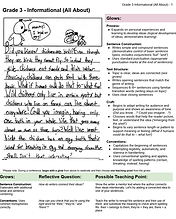
Gr. 3 - Informational (All About)

Gr. 3 - Narrative (Small Moment)

Gr. 3 - Narrative (Diary Fiction)

Gr. 3 - Narrative (Fantasy)


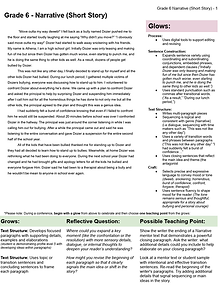


The following video introduces these annotated writing samples that complement the Grades 4–9 Learning Progressions for Writing. Explore how the Glow, Grow, and Coaching annotations connect student work to grade-level expectations and support both teaching and learning.
CONFERENCING TOOLS

Process for Writing Conferences

Gr. 4-6 Writing Conferencing and Reflection Tool

Gr. 7-9 Writing Conferencing and Reflection Tool
CAPTURING EVIDENCE IN EDPLAN INSIGHT
EdPlan Insight provides a simple and powerful way to record and track student progress using the Grades 4–9 Learning Progressions for Writing. This live assessment grid makes it easy to see where students are demonstrating proficiency, identify next steps, and plan targeted supports.
Watch the video below to learn how to use EdPlan Insight with the Grades 4–9 Learning Progressions for Writing.
*please note that the profile numbers have changed but the process is the same.
PROFESSIONAL TEXTS
What instructional strategies and next steps can I take to be responsive to the needs of my students, and support the development of their writing development? Here are some of our favourite resources to support writing development in the classroom. Click on the images below to learn more.


REFERENCES
Culham, R. (2005). 6+1 traits of writing: The complete guide for the primary grades. Scholastic. 6+1 Traits of Writing: The Complete Guide for the Primary Grades
Graham, S., Bollinger, A., Booth Olson, C., D’Aoust, C., MacArthur, C., McCutchen, D., & Olinghouse, N. (2012). Teaching elementary school students to be effective writers: A practice guide (NCEE 2012-4058). National Center for Education Evaluation and Regional Assistance, Institute of Education Sciences, U.S. Department of Education. Teaching Elementary School Students to Be Effective Writers
Graham, S., Bruch, J., Fitzgerald, J., Friedrich, L., Furgeson, J., Greene, K., Kim, J., Lyskawa, J., Olson, C. B., & Smither Wulsin, C. (2016). Teaching secondary students to write effectively (NCEE 2017-4002). National Center for Education Evaluation and Regional Assistance, Institute of Education Sciences, U.S. Department of Education. Teaching Secondary Students to Write Effectively
Huot, B. (1996). Toward a new theory of writing assessment. College Composition and Communication, 47(4), 549–566. Toward a New Theory of Writing Assessment
Manitoba Education. (2020). Kindergarten to Grade 12 English language arts curriculum framework: A living document. Kindergarten to Grade 12 English Language Arts Curriculum Framework: A Living Document
McLean, E., & Griffiths, K. (2022). Writing and writing instruction: An overview of the literature. Australian Education Research Organisation. Writing and Writing Instruction: An Overview of the Literature
Myhill, D. (2021). Grammar re-imagined: Foregrounding understanding of language choice in writing. English in Education, 55(3), 265–278. Grammar Re-imagined: Foregrounding Understanding of Language Choice in Writing
Santiago Schwarz, V., & Hamman-Ortiz, L. (2020). Systemic functional linguistics, teacher education, and writing outcomes for U.S. elementary English learners: A review of the literature. Journal of Second Language Writing, 49, 100727. Systemic Functional Linguistics, Teacher Education, and Writing Outcomes for U.S. Elementary English Learners
Smith, C. B. (Ed.). (2003). Successful use of the six traits in writing: ERIC topical bibliography and commentary. ERIC Clearinghouse on Reading, English, and Communication. Successful Use of the Six Traits in Writing
Wilson, J. (2019). Assessing writing. In S. Graham, C. A. MacArthur, & M. A. Hebert (Eds.), Best practices in writing instruction (3rd ed., pp. 333–360). Guilford Press. Best Practices in Writing Instruction